Place value and big numbers
Students start the year working with larger whole numbers and using addition, subtraction, multiplication, and division to solve word problems. They learn to estimate to check if an answer makes sense.
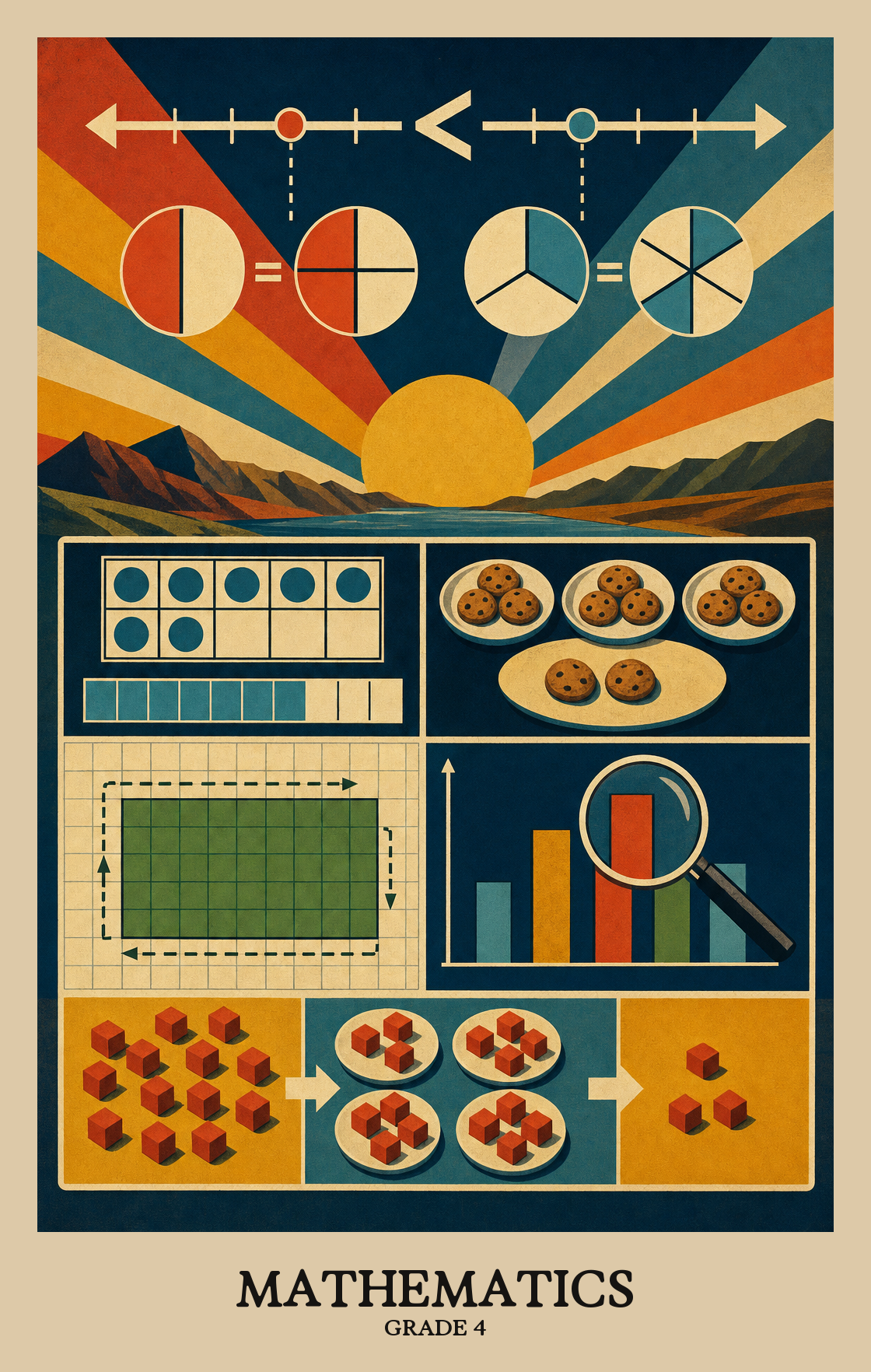
This is the year fractions start to feel like real numbers students can compare, add, and break apart. Students find equal fractions, line them up with the symbols for greater than and less than, and see how a fraction like 7/10 is the same as the decimal 0.7. Multi-step word problems get longer, and students decide what a leftover means when something doesn't divide evenly. By spring, they can find the area and perimeter of a rectangle and read a bar graph to answer a question about it.
Students start the year working with larger whole numbers and using addition, subtraction, multiplication, and division to solve word problems. They learn to estimate to check if an answer makes sense.
Students divide larger numbers and figure out what the leftover amount means in a real situation, like how many vans are needed for a field trip. They explain why their answer fits the problem.
Students build number patterns from a rule and describe the rule behind a pattern someone else made. They notice what changes step by step and what stays the same.
Students learn that fractions like one half and two fourths name the same amount. They compare fractions, add and subtract fractions with the same bottom number, and multiply a fraction by a whole number.
Students see that fractions with tenths and hundredths can also be written as decimals, the same way money works. They compare two decimals and explain which is larger.
Students sort shapes by their sides and angles, estimate the size of an angle, and find the area and perimeter of rectangles. They also solve problems with time, distance, weight, and money, and read data from graphs and line plots.
Students compare and match fractions by figuring out which ones are equal and which are larger or smaller. They work with everyday fractions like halves, thirds, fourths, and tenths.
Two fractions can name the same amount even when they use different numbers. Students show why, using a drawing, a number line, or a model like a fraction bar.
Students learn that fractions like 1/2 and 2/4 name the same amount, then practice writing their own equivalent pairs using denominators up to 100.
Students compare two fractions and explain which is larger, smaller, or equal, using the symbols >, =, or <. They also show their reasoning, not just the answer.
Students build on what they already know about adding and multiplying whole numbers, then apply those same ideas to fractions. The work moves from whole numbers to parts of a whole.
Adding and subtracting fractions gets easier when the bottom numbers match. Students solve problems that combine or separate fractions and mixed numbers that share the same denominator.
Students learn to multiply a fraction by a whole number, such as finding how much total pizza three people get if each receives two-thirds of a pie. They practice setting up and solving these problems in real contexts.
Fractions with a bottom number of 10 or 100 can be written as decimals. Students learn to switch between both forms and use a number line or grid to compare them.
Fractions and decimals are two ways to write the same amount. Students learn to see that one-half and 0.5 name the same value, so they can move between fraction and decimal form without changing what the number means.
Compare two decimal numbers, like 0.4 and 0.37, using the symbols >, =, or <. Students also explain why one number is greater, equal to, or less than the other.
| Standard | Definition | Code |
|---|---|---|
| Extend understanding of fraction equivalence and ordering | Students compare and match fractions by figuring out which ones are equal and which are larger or smaller. They work with everyday fractions like halves, thirds, fourths, and tenths. | 4.NF.A |
| Explain and/or illustrate why two fractions are equivalent | Two fractions can name the same amount even when they use different numbers. Students show why, using a drawing, a number line, or a model like a fraction bar. | 4.NF.A.1 |
| Recognize and generate equivalent fractions | Students learn that fractions like 1/2 and 2/4 name the same amount, then practice writing their own equivalent pairs using denominators up to 100. | 4.NF.A.2 |
| Compare two fractions using the symbols >, = or < | Students compare two fractions and explain which is larger, smaller, or equal, using the symbols >, =, or <. They also show their reasoning, not just the answer. | 4.NF.A.3 |
| Extend understanding of operations on whole numbers to fraction operations | Students build on what they already know about adding and multiplying whole numbers, then apply those same ideas to fractions. The work moves from whole numbers to parts of a whole. | 4.NF.B |
| Solve problems involving adding and subtracting fractions and mixed numbers… | Adding and subtracting fractions gets easier when the bottom numbers match. Students solve problems that combine or separate fractions and mixed numbers that share the same denominator. | 4.NF.B.6 |
| Solve problems involving multiplication of a fraction by a whole number | Students learn to multiply a fraction by a whole number, such as finding how much total pizza three people get if each receives two-thirds of a pie. They practice setting up and solving these problems in real contexts. | 4.NF.B.8 |
| Understand decimal notation for fractions | Fractions with a bottom number of 10 or 100 can be written as decimals. Students learn to switch between both forms and use a number line or grid to compare them. | 4.NF.C |
| Understand that fractions and decimals are equivalent representations of the… | Fractions and decimals are two ways to write the same amount. Students learn to see that one-half and 0.5 name the same value, so they can move between fraction and decimal form without changing what the number means. | 4.NF.C.10 |
| Compare two decimals to the hundredths place using the symbols >, = or < | Compare two decimal numbers, like 0.4 and 0.37, using the symbols >, =, or <. Students also explain why one number is greater, equal to, or less than the other. | 4.NF.C.12 |
Students use addition, subtraction, multiplication, and division to solve word problems with whole numbers. They figure out which operation fits the situation and show their work clearly.
Multi-step word problems ask students to add, subtract, multiply, and divide whole numbers in the right order to reach an answer. Students also check whether their answer makes sense by estimating before or after they solve.
Division problems sometimes have leftovers. Students figure out what those leftovers mean in context, decide whether to round up, drop the remainder, or use it as a fraction, and explain why their choice makes sense.
Students create a number or shape pattern using a rule, then describe what they notice about how the pattern grows or repeats.
Students follow a rule, like "add 5 each time," to build a number sequence from scratch. They practice spotting how a pattern grows so they can predict what comes next.
Students look at a number or shape pattern and write a rule that explains how it works. For example, they might write "add 5 each time" or use a simple equation to show the pattern.
| Standard | Definition | Code |
|---|---|---|
| Use the four operations with whole numbers to solve problems | Students use addition, subtraction, multiplication, and division to solve word problems with whole numbers. They figure out which operation fits the situation and show their work clearly. | 4.RA.A |
| Solve multi-step whole number problems involving the four operations and… | Multi-step word problems ask students to add, subtract, multiply, and divide whole numbers in the right order to reach an answer. Students also check whether their answer makes sense by estimating before or after they solve. | 4.RA.A.2 |
| Solve whole number division problems involving variables in which remainders… | Division problems sometimes have leftovers. Students figure out what those leftovers mean in context, decide whether to round up, drop the remainder, or use it as a fraction, and explain why their choice makes sense. | 4.RA.A.3 |
| Generate and analyze patterns | Students create a number or shape pattern using a rule, then describe what they notice about how the pattern grows or repeats. | 4.RA.C |
| Generate a number pattern that follows a given rule | Students follow a rule, like "add 5 each time," to build a number sequence from scratch. They practice spotting how a pattern grows so they can predict what comes next. | 4.RA.C.6 |
| Use words or mathematical symbols to express a rule for a given pattern | Students look at a number or shape pattern and write a rule that explains how it works. For example, they might write "add 5 each time" or use a simple equation to show the pattern. | 4.RA.C.7 |
Students sort flat shapes by their sides and angles, deciding whether lines are straight, parallel, or perpendicular and whether corners are right angles or not.
Students sort shapes by counting their sides and measuring their angles. A square has four equal sides and four right angles; a triangle might have two equal sides or none.
Students learn what an angle is and practice measuring angles in degrees, the way you'd read a thermometer but for turns and corners. They use a protractor to find the exact measure of an angle in a shape or diagram.
Students look at angles in shapes and diagrams, then judge whether each one is smaller or larger than a right angle and estimate how many degrees it measures before checking with a protractor.
Students measure length, weight, time, and liquid amounts, then convert between units, like turning hours into minutes or feet into inches. The focus is on moving from bigger units down to smaller ones.
Students use addition, subtraction, multiplication, and division to solve real problems involving miles, minutes, gallons, pounds, and dollars. The math is familiar; the context changes.
Students use multiplication to find how much space fills a rectangle (area) and addition to find the total distance around its edges (perimeter). Both skills show up in real problems, like figuring out how much carpet a room needs or how much fence a yard requires.
| Standard | Definition | Code |
|---|---|---|
| Classify 2-dimensional shapes by properties of their lines and angles | Students sort flat shapes by their sides and angles, deciding whether lines are straight, parallel, or perpendicular and whether corners are right angles or not. | 4.GM.A |
| Classify two-dimensional shapes by their sides and/or angles | Students sort shapes by counting their sides and measuring their angles. A square has four equal sides and four right angles; a triangle might have two equal sides or none. | 4.GM.A.2 |
| Understand the concepts of angle and measure angles | Students learn what an angle is and practice measuring angles in degrees, the way you'd read a thermometer but for turns and corners. They use a protractor to find the exact measure of an angle in a shape or diagram. | 4.GM.B |
| Identify and estimate angles and their measure | Students look at angles in shapes and diagrams, then judge whether each one is smaller or larger than a right angle and estimate how many degrees it measures before checking with a protractor. | 4.GM.B.4 |
| Solve problems involving measurement and conversion of measurements from… | Students measure length, weight, time, and liquid amounts, then convert between units, like turning hours into minutes or feet into inches. The focus is on moving from bigger units down to smaller ones. | 4.GM.C |
| Use the four operations to solve problems involving distances, intervals of… | Students use addition, subtraction, multiplication, and division to solve real problems involving miles, minutes, gallons, pounds, and dollars. The math is familiar; the context changes. | 4.GM.C.7 |
| Apply the area and perimeter formulas for rectangles to solve problems | Students use multiplication to find how much space fills a rectangle (area) and addition to find the total distance around its edges (perimeter). Both skills show up in real problems, like figuring out how much carpet a room needs or how much fence a yard requires. | 4.GM.C.8 |
Students collect, display, and make sense of real data, reading graphs and charts to spot patterns and answer questions about what the numbers show.
Students read charts and graphs to answer questions about a data set. They look at how many times something appears, compare amounts across categories, and draw conclusions from what the numbers show.
| Standard | Definition | Code |
|---|---|---|
| Represent and analyze data | Students collect, display, and make sense of real data, reading graphs and charts to spot patterns and answer questions about what the numbers show. | 4.DS.A |
| Analyze the data in a frequency table, line plot, bar graph or picture graph | Students read charts and graphs to answer questions about a data set. They look at how many times something appears, compare amounts across categories, and draw conclusions from what the numbers show. | 4.DS.A.3 |
Missouri Assessment Program grade-level mathematics assessment for grades 3 through 8.
Alternate assessment for eligible students with significant cognitive disabilities, covering the state-tested grade-level and end-of-course subjects.
Federally administered sample-based assessment in reading, mathematics, science, writing, and other subjects. NAEP results inform state-by-state comparisons rather than individual student or school accountability.
Students should add and subtract fractions with the same bottom number, multiply a fraction by a whole number, and compare decimals like 0.45 and 0.7. They should also solve multi-step word problems with all four operations and find the area and perimeter of rectangles.
Cook and measure together. Halves, thirds, and quarters of a cup show up constantly in recipes, and asking which is bigger or how two halves make a whole builds real fraction sense. Cutting a pizza or a sandwich into equal pieces works just as well.
Students learn that 1/10 and 0.1 are two ways to write the same amount, and the same goes for 1/100 and 0.01. Money is the easiest bridge: a quarter is 25 cents, 1/4 of a dollar, and 0.25 all at once.
Start with equivalence and comparison using visual models, then move to adding and subtracting with like denominators once students trust that 2/4 and 1/2 are the same amount. Save multiplying a fraction by a whole number for later, and connect decimals to fractions of 10 and 100 near the end.
Comparing fractions with different bottom numbers, interpreting remainders in division word problems, and reading angles on a protractor. Plan to revisit these in short bursts across the year rather than teaching them once and moving on.
Ask students to retell the problem in their own words before picking an operation. Have them estimate the answer first, then check whether the final number is reasonable. This catches the common mistake of multiplying when the problem really calls for division.
Point out right angles, smaller angles, and bigger angles in doors, books, and street signs. Ask whether a shape has parallel sides or equal sides. A ruler and a piece of grid paper are enough to draw rectangles and find the area and perimeter.
By spring, students should compare fractions and decimals fluently, solve two-step and three-step word problems with reasonable estimates, and explain a pattern using a rule. If those feel solid, the jump to operating on fractions with unlike denominators next year will be much smoother.