Reading and writing stories
Students read stories and pull out the theme, track how characters change, and notice what phrases like comparisons really mean. They write their own stories with a setting, characters, and a problem that gets solved.
This is the year reading and writing shift from following a story to explaining how it works. Students pull out the theme of a story, track how characters change, and figure out what a writer means by a comparison like "quiet as snow." In their own writing, they share an opinion and back it up with reasons from the book or article. By spring, students can write a short paper that states what they think and points to evidence that proves it.
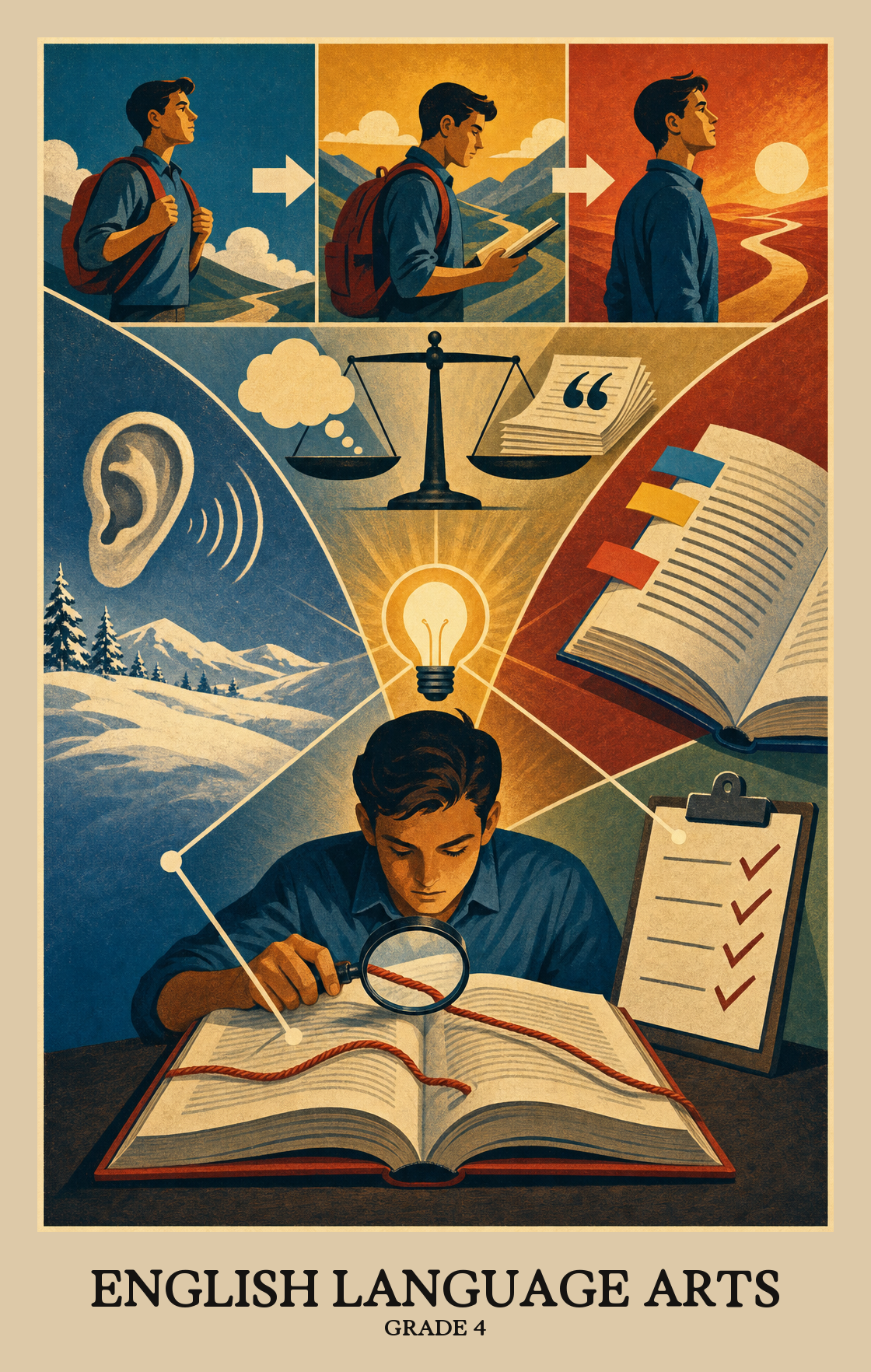
Students read stories and pull out the theme, track how characters change, and notice what phrases like comparisons really mean. They write their own stories with a setting, characters, and a problem that gets solved.
Students read articles and books that teach about a topic. They find the main idea, pick out key details, and notice how word choice matters. Then they write their own pieces that explain a topic clearly.
Students read pieces where authors take a side and look at how the reasons and evidence hold up. They write their own opinion pieces, state what they think, back it with reasons, and end with a clear closing.
Students walk through how they solved a math problem and why their steps work. In science, they ask questions about how things happen, gather evidence, and write explanations that match what they observed.
Students read different accounts of the same event and notice where the sources agree, where they disagree, and which ones to trust. They use details from more than one source to back up a claim of their own.
Reading a story or poem, students explain what it means in their own words, with help from a teacher or classmate.
Students read a story and figure out the big lesson it's teaching, using specific details from the text as evidence for that idea.
Students look at a character in a story and track how that person changes as events unfold. They explain what the character does, why, and what those choices show about who the character is becoming.
Students figure out what words and phrases mean in a story, including comparisons like "her smile was the sun" or "he ran like the wind."
Students write a short story or personal narrative with some guidance from a teacher. They practice putting events in order, choosing details that bring the story to life, and keeping a clear focus from beginning to end.
Students set the scene at the start of a story by introducing who is in it, where it takes place, and what is happening before the main action begins.
Students write about the people or creatures in a story, showing what they look like, how they act, and how they feel about each other.
Students write a story with a real problem and a solution, using time words and event order to show how the story moves from beginning to end.
Students practice tailoring a story or personal narrative to fit who will read or hear it, choosing words and details that make sense for that audience.
Reading a nonfiction article or textbook passage, students explain what the text says and what it means, using details from the text to back up their thinking.
Students find the most important idea in a nonfiction passage and explain it in their own words, using key details from the text to back it up.
Students read an informational passage and look closely at the details and examples an author uses to figure out what makes a person, place, or thing worth writing about.
Students read a nonfiction passage and think about why the author chose specific words. They explain how those word choices change the feeling or meaning of the text.
Students write a short informational piece about a language arts topic, like how a story works or what a word means, with some guidance from a teacher.
Students write an opening that names and explains the subject so a reader who knows nothing about it can follow along.
Students practice keeping their own feelings out of an informational piece. The writing sticks to facts and explains a topic without taking sides or pushing an opinion.
Students sharpen a piece of writing by adding specific details that explain what something is, what it looks like, how it compares to something else, or what group it belongs to.
Students link ideas across a piece of writing so readers can follow the thread from one paragraph to the next without getting lost.
Reading a story, poem, or other text and explaining what the author is trying to argue or prove. Students find the claim, look for the reasons given, and decide how well the evidence holds up.
Students read a short argument and pick out the main point the writer is trying to prove. They practice separating that central claim from the supporting details around it.
Students read two or more pieces about the same topic and figure out where the authors agree, where they differ, and why those differences matter.
Students read a passage and judge whether the details and reasons the author gives actually back up the main point. They decide if the evidence is strong enough to be convincing.
Students write a persuasive paragraph or short essay making a clear claim and backing it up with reasons from what they have read or learned.
Students pick a topic, state a clear opinion about it, and build out the argument with supporting details. Think of it as writing a short speech where every sentence works to convince the reader.
Students back up an opinion with reasons and facts from what they have read or learned. The goal is to give a reader something solid to stand on, not just a feeling.
Students write arguments the way a formal letter sounds: no slang, complete sentences, and language that fits a serious topic. This is the difference between texting a friend and writing something meant to persuade an adult.
Students write an opinion, back it up with facts and details that actually support it, and wrap up with a closing sentence that ties the argument together.
| Standard | Definition | Code |
|---|---|---|
| Narrate.Interpretive | Reading a story or poem, students explain what it means in their own words, with help from a teacher or classmate. | ELD-LA.4-5.1 |
| Identifying a theme from details | Students read a story and figure out the big lesson it's teaching, using specific details from the text as evidence for that idea. | ELD-LA.4-5.1.1 |
| Analyzing how character attributes and actions develop across event sequences | Students look at a character in a story and track how that person changes as events unfold. They explain what the character does, why, and what those choices show about who the character is becoming. | ELD-LA.4-5.1.2 |
| Determining the meaning of words and phrases used in texts, including… | Students figure out what words and phrases mean in a story, including comparisons like "her smile was the sun" or "he ran like the wind." | ELD-LA.4-5.1.3 |
| Narrate.Expressive: Construct language arts narratives | Students write a short story or personal narrative with some guidance from a teacher. They practice putting events in order, choosing details that bring the story to life, and keeping a clear focus from beginning to end. | ELD-LA.4-5.2 |
| Orient audience to context | Students set the scene at the start of a story by introducing who is in it, where it takes place, and what is happening before the main action begins. | ELD-LA.4-5.2.1 |
| Develop and describe characters and their relationships | Students write about the people or creatures in a story, showing what they look like, how they act, and how they feel about each other. | ELD-LA.4-5.2.2 |
| Develop story with complication and resolution, time and event sequences | Students write a story with a real problem and a solution, using time words and event order to show how the story moves from beginning to end. | ELD-LA.4-5.2.3 |
| Engage and adjust for audience | Students practice tailoring a story or personal narrative to fit who will read or hear it, choosing words and details that make sense for that audience. | ELD-LA.4-5.2.4 |
| Inform.Interpretive: Interpret informational texts in language arts | Reading a nonfiction article or textbook passage, students explain what the text says and what it means, using details from the text to back up their thinking. | ELD-LA.4-5.3 |
| Identifying and summarizing main ideas and key details | Students find the most important idea in a nonfiction passage and explain it in their own words, using key details from the text to back it up. | ELD-LA.4-5.3.1 |
| Analyzing details and examples for key attributes, qualities | Students read an informational passage and look closely at the details and examples an author uses to figure out what makes a person, place, or thing worth writing about. | ELD-LA.4-5.3.2 |
| Evaluating the impact of key word choices in a text | Students read a nonfiction passage and think about why the author chose specific words. They explain how those word choices change the feeling or meaning of the text. | ELD-LA.4-5.3.3 |
| Inform.Expressive: Construct informational texts in language arts | Students write a short informational piece about a language arts topic, like how a story works or what a word means, with some guidance from a teacher. | ELD-LA.4-5.4 |
| Introduce and define topic and/or entity for audience | Students write an opening that names and explains the subject so a reader who knows nothing about it can follow along. | ELD-LA.4-5.4.1 |
| Establish objective or neutral stance | Students practice keeping their own feelings out of an informational piece. The writing sticks to facts and explains a topic without taking sides or pushing an opinion. | ELD-LA.4-5.4.2 |
| Add precision and details to define, describe, compare | Students sharpen a piece of writing by adding specific details that explain what something is, what it looks like, how it compares to something else, or what group it belongs to. | ELD-LA.4-5.4.3 |
| Develop coherence and cohesion throughout text | Students link ideas across a piece of writing so readers can follow the thread from one paragraph to the next without getting lost. | ELD-LA.4-5.4.4 |
| Argue.Interpretive: Interpret language arts arguments by | Reading a story, poem, or other text and explaining what the author is trying to argue or prove. Students find the claim, look for the reasons given, and decide how well the evidence holds up. | ELD-LA.4-5.5 |
| Identifying main ideas | Students read a short argument and pick out the main point the writer is trying to prove. They practice separating that central claim from the supporting details around it. | ELD-LA.4-5.5.1 |
| Analyzing points of view about the same event or topic | Students read two or more pieces about the same topic and figure out where the authors agree, where they differ, and why those differences matter. | ELD-LA.4-5.5.2 |
| Evaluating how details, reasons | Students read a passage and judge whether the details and reasons the author gives actually back up the main point. They decide if the evidence is strong enough to be convincing. | ELD-LA.4-5.5.3 |
| Argue.Expressive: Construct language arts arguments that | Students write a persuasive paragraph or short essay making a clear claim and backing it up with reasons from what they have read or learned. | ELD-LA.4-5.6 |
| Introduce and develop a topic clearly | Students pick a topic, state a clear opinion about it, and build out the argument with supporting details. Think of it as writing a short speech where every sentence works to convince the reader. | ELD-LA.4-5.6.1 |
| Support opinions with reasons and information | Students back up an opinion with reasons and facts from what they have read or learned. The goal is to give a reader something solid to stand on, not just a feeling. | ELD-LA.4-5.6.2 |
| Use a formal style | Students write arguments the way a formal letter sounds: no slang, complete sentences, and language that fits a serious topic. This is the difference between texting a friend and writing something meant to persuade an adult. | ELD-LA.4-5.6.3 |
| Logically connect opinions to appropriate evidence, facts | Students write an opinion, back it up with facts and details that actually support it, and wrap up with a closing sentence that ties the argument together. | ELD-LA.4-5.6.4 |
Reading or listening to someone explain a math solution and making sense of what they mean. Students figure out the reasoning behind the steps, not just the answer.
Reading a math explanation and pinpointing the main idea or object being described, such as a fraction, a shape, or a number pattern.
Students read a math explanation written by someone else and figure out whether the steps make sense. They look for where the reasoning holds up and where it breaks down.
Students look at a number pattern or shape arrangement, figure out the rule behind it, and decide whether the pattern actually follows that rule.
Students write out their math thinking in words and sentences, explaining how they solved a problem or why an answer makes sense. The goal is a clear explanation another person could follow.
Students write a sentence or two that names a math idea, like what a fraction or an angle is, so a reader who has never seen it before can follow the rest of the explanation.
Students explain how they solved a math problem so a classmate can follow their steps. The focus is on talking or writing through the work clearly enough that someone else understands it.
Students put math thinking into words, describing what a graph or chart shows or walking through the steps they took to solve a problem.
Students write out the thinking behind their answer, not just the answer itself. They explain the steps they took or why their approach makes sense.
Reading a math explanation someone else wrote and deciding whether their reasoning makes sense and their conclusion holds up.
Students look at a math pattern or rule someone else noticed and decide whether it holds up. They check it against what they already know and explain whether they agree.
Students read two math explanations side by side and find what the reasoning has in common, then spot where it breaks apart.
Students look at several solved math problems, find the pattern in how they were solved, and write a rule that works every time. This is the beginning of algebraic thinking.
Students build a math argument by explaining their reasoning in writing or speech, showing not just the answer but why it makes sense using numbers, pictures, or examples.
Students make a mathematical guess and back it up. They look at a pattern or rule, decide what they think is true, and explain why using what they already know about numbers or shapes.
Students look at several math examples and explain what they all have in common, or where they differ. This is the work of building a real argument in math, not just solving a problem.
Students back up a math conclusion by showing the pattern or rule that proves it. They explain why the answer works, not just what the answer is.
Students listen to a classmate's math explanation and decide whether the reasoning holds up. They point to a specific step or number that either supports or weakens the argument.
| Standard | Definition | Code |
|---|---|---|
| Explain.Interpretive | Reading or listening to someone explain a math solution and making sense of what they mean. Students figure out the reasoning behind the steps, not just the answer. | ELD-MA.4-5.1 |
| Identifying concept or entity | Reading a math explanation and pinpointing the main idea or object being described, such as a fraction, a shape, or a number pattern. | ELD-MA.4-5.1.1 |
| Analyzing problem-solving steps | Students read a math explanation written by someone else and figure out whether the steps make sense. They look for where the reasoning holds up and where it breaks down. | ELD-MA.4-5.1.2 |
| Evaluating a pattern or structure that follows a given rule | Students look at a number pattern or shape arrangement, figure out the rule behind it, and decide whether the pattern actually follows that rule. | ELD-MA.4-5.1.3 |
| Explain.Expressive: Construct mathematical explanations that | Students write out their math thinking in words and sentences, explaining how they solved a problem or why an answer makes sense. The goal is a clear explanation another person could follow. | ELD-MA.4-5.2 |
| Introduce concept or entity | Students write a sentence or two that names a math idea, like what a fraction or an angle is, so a reader who has never seen it before can follow the rest of the explanation. | ELD-MA.4-5.2.1 |
| Share solution with others | Students explain how they solved a math problem so a classmate can follow their steps. The focus is on talking or writing through the work clearly enough that someone else understands it. | ELD-MA.4-5.2.2 |
| Describe data and/or steps to solve problem | Students put math thinking into words, describing what a graph or chart shows or walking through the steps they took to solve a problem. | ELD-MA.4-5.2.3 |
| State reasoning used to generate solution | Students write out the thinking behind their answer, not just the answer itself. They explain the steps they took or why their approach makes sense. | ELD-MA.4-5.2.4 |
| Argue.Interpretive: Interpret mathematics arguments by | Reading a math explanation someone else wrote and deciding whether their reasoning makes sense and their conclusion holds up. | ELD-MA.4-5.3 |
| Comparing conjectures with patterns, and/or rules | Students look at a math pattern or rule someone else noticed and decide whether it holds up. They check it against what they already know and explain whether they agree. | ELD-MA.4-5.3.1 |
| Distinguishing commonalities and differences among ideas in justifications | Students read two math explanations side by side and find what the reasoning has in common, then spot where it breaks apart. | ELD-MA.4-5.3.2 |
| Extracting patterns or rules from solution strategies to create generalizations | Students look at several solved math problems, find the pattern in how they were solved, and write a rule that works every time. This is the beginning of algebraic thinking. | ELD-MA.4-5.3.3 |
| Argue.Expressive: Construct mathematics arguments that | Students build a math argument by explaining their reasoning in writing or speech, showing not just the answer but why it makes sense using numbers, pictures, or examples. | ELD-MA.4-5.4 |
| Create conjecture using definitions, patterns | Students make a mathematical guess and back it up. They look at a pattern or rule, decide what they think is true, and explain why using what they already know about numbers or shapes. | ELD-MA.4-5.4.1 |
| Generalize commonalities and differences across cases | Students look at several math examples and explain what they all have in common, or where they differ. This is the work of building a real argument in math, not just solving a problem. | ELD-MA.4-5.4.2 |
| Justify conclusions with patterns or rules | Students back up a math conclusion by showing the pattern or rule that proves it. They explain why the answer works, not just what the answer is. | ELD-MA.4-5.4.3 |
| Evaluate others’ arguments | Students listen to a classmate's math explanation and decide whether the reasoning holds up. They point to a specific step or number that either supports or weakens the argument. | ELD-MA.4-5.4.4 |
Reading science texts, diagrams, or experiments and putting the meaning into their own words. Students figure out what a scientific explanation is saying and show they understood it.
Students read or listen to a science explanation, then put the key ideas into their own words to show they understood what happened and why.
Students read science texts and pull out key details to piece together why something happens in nature, like why seasons change or why volcanoes erupt. They combine what they find from multiple sources into one clear explanation.
Students read a science explanation and point to the specific facts or details that back up each claim the author makes.
Students write a science explanation in their own words, using what they observed or read as evidence. The explanation should show not just what happened, but why.
Students read about two or more solutions to a real problem, then write a summary or comparison explaining which solution works best and why, based on specific requirements and limits.
Reading a scientific claim and explaining what evidence supports it. Students identify what the author is trying to prove and whether the facts and details given actually back it up.
Students read scientific data or diagrams and pick out the details that actually support an argument. They practice separating useful evidence from information that doesn't answer the question.
Students read two science passages and decide which one makes a stronger case, looking at the reasons each author gives and whether the facts actually back them up.
Students learn to spot the difference between a hard fact, a conclusion scientists drew from research, and a guess that hasn't been proven yet. Reading science text, they ask: is this known, figured out, or just possible?
Students build a written argument using science evidence, explaining what they observed and why it supports their claim. They learn to put observations and data into words that make a case.
Students write an opening sentence that names the science topic or real-world issue they are arguing about, giving readers a clear reason to keep reading.
Students pick a position on a science topic and back it up with evidence from data or a model. The claim has to be clear enough that someone else could read it and understand exactly what students are arguing.
Students practice writing about science topics without letting personal opinions color the explanation. The goal is to sound like a reporter, not an advocate: stating what the evidence shows, not what students wish were true.
Students write or speak a scientific claim and then connect their reasoning to evidence or data that actually backs it up, showing how each piece of proof supports the point they're making.
| Standard | Definition | Code |
|---|---|---|
| Explain.Interpretive | Reading science texts, diagrams, or experiments and putting the meaning into their own words. Students figure out what a scientific explanation is saying and show they understood it. | ELD-SC.4-5.1 |
| Defining investigable questions or design problems based on observations, data | Students read or listen to a science explanation, then put the key ideas into their own words to show they understood what happened and why. | ELD-SC.4-5.1.1 |
| Obtaining and combining evidence and information to help explain how or why a… | Students read science texts and pull out key details to piece together why something happens in nature, like why seasons change or why volcanoes erupt. They combine what they find from multiple sources into one clear explanation. | ELD-SC.4-5.1.2 |
| Identifying evidence that supports particular points in an explanation | Students read a science explanation and point to the specific facts or details that back up each claim the author makes. | ELD-SC.4-5.1.3 |
| Explain.Expressive: Construct scientific explanations that | Students write a science explanation in their own words, using what they observed or read as evidence. The explanation should show not just what happened, but why. | ELD-SC.4-5.2 |
| Summarize and/or compare multiple solutions to a problem based on how well they… | Students read about two or more solutions to a real problem, then write a summary or comparison explaining which solution works best and why, based on specific requirements and limits. | ELD-SC.4-5.1.4 |
| Argue.Interpretive: Interpret scientific arguments by | Reading a scientific claim and explaining what evidence supports it. Students identify what the author is trying to prove and whether the facts and details given actually back it up. | ELD-SC.4-5.3 |
| Identifying relevant evidence from data, models, and/or information from… | Students read scientific data or diagrams and pick out the details that actually support an argument. They practice separating useful evidence from information that doesn't answer the question. | ELD-SC.4-5.3.1 |
| Comparing reasoning and claims based on evidence | Students read two science passages and decide which one makes a stronger case, looking at the reasons each author gives and whether the facts actually back them up. | ELD-SC.4-5.3.2 |
| Distinguishing among facts, reasoned judgment based on research findings | Students learn to spot the difference between a hard fact, a conclusion scientists drew from research, and a guess that hasn't been proven yet. Reading science text, they ask: is this known, figured out, or just possible? | ELD-SC.4-5.3.3 |
| Argue.Expressive Construct scientific arguments that | Students build a written argument using science evidence, explaining what they observed and why it supports their claim. They learn to put observations and data into words that make a case. | ELD-SC.4-5.4 |
| Introduce topic/phenomenon in issues related to the natural and designed world | Students write an opening sentence that names the science topic or real-world issue they are arguing about, giving readers a clear reason to keep reading. | ELD-SC.4-5.4.1 |
| Make and define a claim based on evidence, data, and/or model | Students pick a position on a science topic and back it up with evidence from data or a model. The claim has to be clear enough that someone else could read it and understand exactly what students are arguing. | ELD-SC.4-5.4.2 |
| Establish a neutral tone or an objective stance | Students practice writing about science topics without letting personal opinions color the explanation. The goal is to sound like a reporter, not an advocate: stating what the evidence shows, not what students wish were true. | ELD-SC.4-5.4.3 |
| Signal logical relationships among reasoning, relevant evidence, data, and/or a… | Students write or speak a scientific claim and then connect their reasoning to evidence or data that actually backs it up, showing how each piece of proof supports the point they're making. | ELD-SC.4-5.4.4 |
Reading a social studies passage and putting the main idea into their own words. Students pick out key facts, figure out what they mean, and explain the bigger picture in a clear sentence or two.
Students read articles or other sources on the same topic and figure out where the authors disagree. They use those differing views to answer questions about why something happened or what it means.
Students read a source (an article, a map, or a primary document) and identify several reasons why an event happened, then explain how those reasons connect.
Students read about a historical event or social studies topic where experts disagree, then decide which interpretation makes more sense based on the evidence. They explain why reasonable people can read the same facts differently.
Students write sentences or short paragraphs that explain a social studies topic, walking through causes, effects, or key facts in their own words.
Students write an opening sentence or paragraph that names the event or topic they are explaining, giving readers enough context to follow what comes next.
Students write explanations about how something in social studies works, using examples and details to show steps, causes, or what happens next.
Students look at a historical event or change and explain what likely caused it and what probably happened as a result. They go beyond single facts to spot patterns across multiple examples.
Reading a social studies argument and figuring out what the author is trying to prove. Students identify the main claim and look at the reasons and evidence used to support it.
Students read a social studies passage and figure out what position the author is taking and why they wrote it, whether to argue one side, weigh both sides, or push back on a common idea.
Students read several sources on the same topic, then use what they find to build a claim that answers a bigger question about history or society.
Students read a social studies source and decide whether the author is trustworthy. They separate facts (things that can be checked) from opinions (things the author believes) to judge whether an argument holds up.
Students write a short argument about a social studies topic, like a historical event or a community issue, and back it up with facts and reasons from what they have read or studied.
Students open an argument by naming the topic clearly so readers know exactly what is being discussed before any evidence appears.
Students pick facts and details from more than one source to back up a point they are trying to make. They learn to choose what actually supports their argument and leave out what does not.
Students pick a clear side on a social studies topic and state it in their own words before explaining why they believe it.
Students connect each claim to a reason and back it up with details from more than one source. They show how those pieces fit together to build a clear argument.
| Standard | Definition | Code |
|---|---|---|
| Explain.Interpretive Interpret social studies explanations by | Reading a social studies passage and putting the main idea into their own words. Students pick out key facts, figure out what they mean, and explain the bigger picture in a clear sentence or two. | ELD-SS.4-5.1 |
| Determining different opinions in sources for answering compelling and… | Students read articles or other sources on the same topic and figure out where the authors disagree. They use those differing views to answer questions about why something happened or what it means. | ELD-SS.4-5.1.1 |
| Analyzing sources for a series of contributing factors or causes | Students read a source (an article, a map, or a primary document) and identify several reasons why an event happened, then explain how those reasons connect. | ELD-SS.4-5.1.2 |
| Evaluating disciplinary concepts and ideas that are open to different… | Students read about a historical event or social studies topic where experts disagree, then decide which interpretation makes more sense based on the evidence. They explain why reasonable people can read the same facts differently. | ELD-SS.4-5.1.3 |
| Explain.Expressive: Construct social studies explanations that | Students write sentences or short paragraphs that explain a social studies topic, walking through causes, effects, or key facts in their own words. | ELD-SS.4-5.2 |
| Introduce phenomena or events | Students write an opening sentence or paragraph that names the event or topic they are explaining, giving readers enough context to follow what comes next. | ELD-SS.4-5.2.1 |
| Describe components, order, causes and effects | Students write explanations about how something in social studies works, using examples and details to show steps, causes, or what happens next. | ELD-SS.4-5.2.2 |
| Generalize probable causes and effects of developments or events | Students look at a historical event or change and explain what likely caused it and what probably happened as a result. They go beyond single facts to spot patterns across multiple examples. | ELD-SS.4-5.2.3 |
| Argue.Interpretive: Interpret social studies arguments by | Reading a social studies argument and figuring out what the author is trying to prove. Students identify the main claim and look at the reasons and evidence used to support it. | ELD-SS.4-5.3 |
| Identifying topic and purpose | Students read a social studies passage and figure out what position the author is taking and why they wrote it, whether to argue one side, weigh both sides, or push back on a common idea. | ELD-SS.4-5.3.1 |
| Analyzing relevant information from multiple sources to develop claims in… | Students read several sources on the same topic, then use what they find to build a claim that answers a bigger question about history or society. | ELD-SS.4-5.3.2 |
| Evaluating point of view and credibility of source, based on distinctions… | Students read a social studies source and decide whether the author is trustworthy. They separate facts (things that can be checked) from opinions (things the author believes) to judge whether an argument holds up. | ELD-SS.4-5.3.3 |
| Argue.Expressive: Construct social studies arguments that | Students write a short argument about a social studies topic, like a historical event or a community issue, and back it up with facts and reasons from what they have read or studied. | ELD-SS.4-5.4 |
| Introduce topic | Students open an argument by naming the topic clearly so readers know exactly what is being discussed before any evidence appears. | ELD-SS.4-5.4.1 |
| Select relevant information to support claims with evidence from multiple… | Students pick facts and details from more than one source to back up a point they are trying to make. They learn to choose what actually supports their argument and leave out what does not. | ELD-SS.4-5.4.2 |
| Establish perspective | Students pick a clear side on a social studies topic and state it in their own words before explaining why they believe it. | ELD-SS.4-5.4.3 |
| Show relationships between claims with reasons and multiple sources of evidence | Students connect each claim to a reason and back it up with details from more than one source. They show how those pieces fit together to build a clear argument. | ELD-SS.4-5.4.4 |
End-of-grade reading assessment for grades 3 through 8, aligned to the North Carolina Standard Course of Study.
Alternate assessment for eligible students with significant cognitive disabilities, covering state-tested grades and subjects.
Federally administered sample-based assessment in reading, mathematics, science, writing, and other subjects. NAEP results inform state-by-state comparisons rather than individual student or school accountability.
Students read longer stories and articles and explain what they mean. They write about characters, summarize what they read, and start backing up their opinions with reasons from the text. By spring, written answers should sound more like short paragraphs than single sentences.
After a chapter or article, ask two quick questions: what was it mostly about, and which part proved it. If students get stuck, reread the page together and point at the sentence that gave them the answer. That habit builds the skill teachers are looking for.
A short opinion or informational piece with an opening sentence, two or three reasons or details, and a closing sentence. Spelling and handwriting matter less than whether the reasons actually match the opinion. Stories should have a problem and a solution, not just a list of events.
Start with main idea and key details in shorter texts, then move into character change and word meaning in longer stories. Save argument and point of view for later in the year, once students are comfortable pulling evidence from a single source. Loop back to summary work every few weeks.
Citing evidence from the text and writing a closing sentence that does more than repeat the opening. Figurative language also needs steady practice, since students often read similes and metaphors literally. Build short warm-ups around these instead of full lessons.
Switch who reads. Read a page aloud, then have students read the next page. Audiobooks paired with the printed page also count, as long as eyes are on the words. Five honest minutes beats twenty minutes of arguing.
Teach the parts in order: opinion, reasons, evidence, closing. Then give topics students actually care about, like school rules or weekend activities, so the reasons come from real thinking. Save formal topics for after the structure is solid.
They can read a grade-level article, summarize it in a few sentences, and point to lines that back up their summary. In writing, they can hold an opinion across a short paragraph with reasons that match. Stamina matters too: 20 to 30 minutes of focused reading without drifting.