Mapping the state
Students start the year getting to know North Carolina's mountains, piedmont, and coast. They use maps to see how the land shapes where people live, work, and travel.
This is the year social studies zooms in on North Carolina. Students learn how the state took shape through the people who lived here, the groups who moved here, and the leaders who shaped its laws. They use maps to compare the mountains, piedmont, and coast, and they read old letters and photos to see history from more than one side. By spring, students can name the jobs of state leaders and explain why people came to North Carolina.
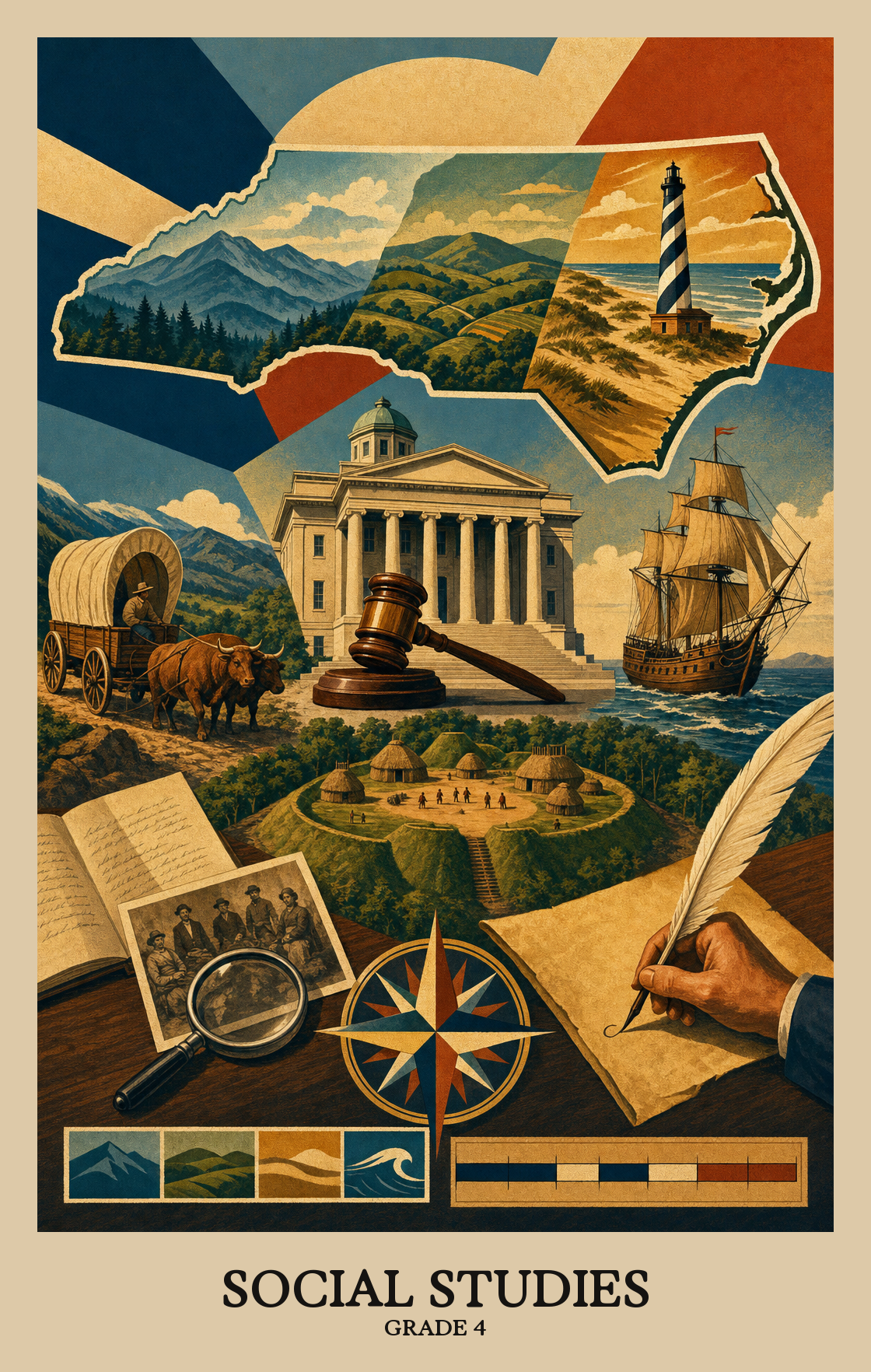
Students start the year getting to know North Carolina's mountains, piedmont, and coast. They use maps to see how the land shapes where people live, work, and travel.
Students learn about the indigenous, religious, and racial groups who built North Carolina. They look at traditions, music, food, and art that still show up in daily life today.
Students study why people came to North Carolina, why some were forced to come, and why others left. They trace how the movement of people and goods changed towns and cities.
Students dig into key moments in the state's history, from major wars to civil rights. They read short primary sources and compare how different people experienced the same event.
Students learn what the governor, legislators, and other state leaders actually do. They look at the state constitution to see the difference between a right and a responsibility.
Students see how scarcity, resources, and industry shape the state's economy. They also practice thinking about saving and spending and how small money choices add up over time.
Students examine how the values and beliefs of North Carolina's people, from early settlers to today, shaped the state's laws, traditions, and sense of identity.
Traditions, social structure, and artistic expression have shaped what makes North Carolina distinct. Students look at how the state's customs, communities, and art forms tell a shared story about who North Carolinians are and where they came from.
Different groups have shaped what North Carolina looks like today. Students explain how the values and beliefs of Native peoples, religious communities, and racial groups left a mark on the state's laws, traditions, and culture.
| Standard | Definition | Code |
|---|---|---|
| Understand ways in which values and beliefs have influenced the development of… | Students examine how the values and beliefs of North Carolina's people, from early settlers to today, shaped the state's laws, traditions, and sense of identity. | 4.B.1 |
| Explain how traditions, social structure | Traditions, social structure, and artistic expression have shaped what makes North Carolina distinct. Students look at how the state's customs, communities, and art forms tell a shared story about who North Carolinians are and where they came from. | 4.B.1.1 |
| Explain how the values and beliefs of various indigenous, religious | Different groups have shaped what North Carolina looks like today. Students explain how the values and beliefs of Native peoples, religious communities, and racial groups left a mark on the state's laws, traditions, and culture. | 4.B.1.2 |
Citizens vote, follow laws, pay taxes, and speak up at local meetings. This standard covers what it means to take part in how towns and states are governed.
Students compare what a governor, state legislator, and other elected leaders actually do on the job, looking at where their responsibilities overlap and where they differ.
Students learn how different groups of people, including women, Native Americans, and religious and racial communities, have shaped the laws and decisions made by local and state governments.
Rights are things students are protected from or guaranteed, like free speech. Responsibilities are duties students owe in return, like following laws. This standard asks students to tell the difference between the two using North Carolina's own constitution.
| Standard | Definition | Code |
|---|---|---|
| Understand the role of citizens in local and state government | Citizens vote, follow laws, pay taxes, and speak up at local meetings. This standard covers what it means to take part in how towns and states are governed. | 4.C&G.1 |
| Compare the roles and responsibilities of state elected leaders | Students compare what a governor, state legislator, and other elected leaders actually do on the job, looking at where their responsibilities overlap and where they differ. | 4.C&G.1.1 |
| Summarize the ways in which women, indigenous, religious | Students learn how different groups of people, including women, Native Americans, and religious and racial communities, have shaped the laws and decisions made by local and state governments. | 4.C&G.1.2 |
| Differentiate between rights and responsibilities reflected in the North… | Rights are things students are protected from or guaranteed, like free speech. Responsibilities are duties students owe in return, like following laws. This standard asks students to tell the difference between the two using North Carolina's own constitution. | 4.C&G.1.3 |
Economic decisions shape what North Carolina makes, sells, and spends. Students learn how choices about money, jobs, and natural resources affect the state's economy.
Scarcity means there is never enough of everything people want. Students learn how shortages of land, workers, or money push North Carolina businesses and families to make trade-offs about what to buy, make, or do.
Students look at why some of North Carolina's big industries (like farming, textiles, or banking) grew during certain periods and struggled during others. They learn to connect real events, like new technology or shifting markets, to changes in jobs and businesses across the state.
Students learn how the land, workers, and tools needed to make something depend on what resources are actually available in North Carolina. A farm near the coast grows different crops than one in the mountains because the land and climate shape what's possible.
Students learn how spending, saving, and borrowing decisions affect their own lives and the people around them. A choice as simple as saving allowance or taking out a loan has real consequences.
Spending and saving choices shape daily life in real ways. Students explore how decisions like buying something now or setting money aside can change what a family can afford later.
Students look at real examples of financial choices, like saving for something big or spending before bills are paid, and explain what happened as a result.
| Standard | Definition | Code |
|---|---|---|
| Understand how economic decisions and resources affect the economy of North… | Economic decisions shape what North Carolina makes, sells, and spends. Students learn how choices about money, jobs, and natural resources affect the state's economy. | 4.E.1 |
| Explain the ways in which scarcity impacts economic decisions in North Carolina | Scarcity means there is never enough of everything people want. Students learn how shortages of land, workers, or money push North Carolina businesses and families to make trade-offs about what to buy, make, or do. | 4.E.1.1 |
| Explain factors that have led to economic growth and decline for North… | Students look at why some of North Carolina's big industries (like farming, textiles, or banking) grew during certain periods and struggled during others. They learn to connect real events, like new technology or shifting markets, to changes in jobs and businesses across the state. | 4.E.1.2 |
| Explain ways in which factors of production are influenced by the availability… | Students learn how the land, workers, and tools needed to make something depend on what resources are actually available in North Carolina. A farm near the coast grows different crops than one in the mountains because the land and climate shape what's possible. | 4.E.1.3 |
| Understand the impact of personal financial | Students learn how spending, saving, and borrowing decisions affect their own lives and the people around them. A choice as simple as saving allowance or taking out a loan has real consequences. | 4.E.2 |
| Explain the way in which personal financial decisions such as spending and… | Spending and saving choices shape daily life in real ways. Students explore how decisions like buying something now or setting money aside can change what a family can afford later. | 4.E.2.1 |
| Exemplify outcomes of positive and negative financial decisions | Students look at real examples of financial choices, like saving for something big or spending before bills are paid, and explain what happened as a result. | 4.E.2.2 |
Geography shapes where towns grew, which crops farmers planted, and how people moved goods across the state. Students learn how North Carolina's mountains, piedmont, and coastal plain influenced the way communities developed over time.
Students use maps and charts to compare North Carolina's regions, such as the Mountains, Piedmont, and Coast, looking at how each region's land and location shaped the way communities grew there.
Maps and timelines show how people moving into North Carolina, goods traveling through it, and ideas spreading across it shaped the state over time. Students use geographic tools to find patterns in that movement.
Students explain why people moved to, from, or across North Carolina, covering both chosen moves (job opportunities, family) and forced ones (slavery, displacement of Native peoples).
| Standard | Definition | Code |
|---|---|---|
| Understand the role geography has played in the development of North Carolina | Geography shapes where towns grew, which crops farmers planted, and how people moved goods across the state. Students learn how North Carolina's mountains, piedmont, and coastal plain influenced the way communities developed over time. | 4.G.1 |
| Compare the development of various geographic regions in North Carolina using… | Students use maps and charts to compare North Carolina's regions, such as the Mountains, Piedmont, and Coast, looking at how each region's land and location shaped the way communities grew there. | 4.G.1.1 |
| Exemplify the ways in which movement of people, goods and ideas has impacted… | Maps and timelines show how people moving into North Carolina, goods traveling through it, and ideas spreading across it shaped the state over time. Students use geographic tools to find patterns in that movement. | 4.G.1.2 |
| Summarize the reasons for forced and voluntary migration to, from | Students explain why people moved to, from, or across North Carolina, covering both chosen moves (job opportunities, family) and forced ones (slavery, displacement of Native peoples). | 4.G.1.3 |
People, events, and ideas all helped shape North Carolina into what it is today. Students learn who those people were, what happened, and why it still matters.
Students learn how people who were often excluded from power, including Black North Carolinians and Native peoples, pushed for change and drove real progress in the state's history.
Students learn how the lives and roles of women, Native Americans, and people of different racial backgrounds changed across different periods of North Carolina history.
Revolution, reform, and resistance have changed North Carolina over time. Students learn how protests, new laws, and acts of rebellion shifted who held power and how people lived in the state.
Students learn how North Carolina contributed to major American wars and turning-point events, from colonial times through the modern era.
Students look at two or more accounts of the same event in North Carolina history, such as a newspaper from the time and a historian's later writing, to see how different people described what happened.
Students look at symbols like the state flag, the cardinal, and the longleaf pine and explain what those symbols mean to different groups of North Carolinians, then and now.
| Standard | Definition | Code |
|---|---|---|
| Understand the role of various people, events, and ideas in shaping… | People, events, and ideas all helped shape North Carolina into what it is today. Students learn who those people were, what happened, and why it still matters. | 4.H.1 |
| Explain how the experiences and achievements of minorities, indigenous groups | Students learn how people who were often excluded from power, including Black North Carolinians and Native peoples, pushed for change and drove real progress in the state's history. | 4.H.1.1 |
| Summarize the changing roles of women, indigenous populations and racial… | Students learn how the lives and roles of women, Native Americans, and people of different racial backgrounds changed across different periods of North Carolina history. | 4.H.1.2 |
| Explain the ways in which revolution, reform | Revolution, reform, and resistance have changed North Carolina over time. Students learn how protests, new laws, and acts of rebellion shifted who held power and how people lived in the state. | 4.H.1.3 |
| Summarize the role North Carolina has played in major conflicts and events… | Students learn how North Carolina contributed to major American wars and turning-point events, from colonial times through the modern era. | 4.H.1.4 |
| Use primary and secondary sources to compare multiple perspectives of various… | Students look at two or more accounts of the same event in North Carolina history, such as a newspaper from the time and a historian's later writing, to see how different people described what happened. | 4.H.1.5 |
| Explain the significance of historical symbols in North Carolina from various… | Students look at symbols like the state flag, the cardinal, and the longleaf pine and explain what those symbols mean to different groups of North Carolinians, then and now. | 4.H.1.6 |
Federally administered sample-based assessment in reading, mathematics, science, writing, and other subjects. NAEP results inform state-by-state comparisons rather than individual student or school accountability.
The year focuses on North Carolina. Students learn about its regions, its history, its state government, its economy, and the many groups of people who shaped it. Expect a lot of maps, timelines, and stories about real people and places.
Take a short trip to a local landmark, museum, or state park and talk about what happened there. Looking at old family photos or asking older relatives about how the area has changed also counts. Ten minutes of real conversation goes a long way.
Students should be able to name the governor and describe what state leaders do, not just federal ones. They should also understand the difference between a right, such as voting, and a responsibility, such as following laws.
Start with geography and the three regions, since those shape every later story. Move into early peoples and migration, then into conflicts, reform, and modern industries. Pulling maps back out during history units keeps the place attached to the events.
Skip the dates and start with a person. Read a short biography of a North Carolinian, watch a five-minute video about an event in the state, or look up why a local street or school got its name. Curiosity about one story usually opens the door.
Scarcity and factors of production trip students up because the vocabulary is abstract. Reading primary sources is also slow going at first. Both get easier with short, repeated practice using local examples rather than one long unit.
Use allowance, birthday money, or a school fundraiser as the example. Talk through a real choice: if money is spent on one thing, it cannot be spent on another. That conversation teaches scarcity better than any worksheet.
Pair a short primary source with a short secondary source on the same event and ask what each one notices and leaves out. Keep the readings brief and the questions concrete. Students can handle complexity when the text load stays manageable.
Students should be able to locate North Carolina on a map, name its three regions, describe a few key people and events from state history, and explain why people moved to or from the state. Being able to back up an answer with a reason matters more than memorising dates.