Forces you cannot see
Students start the year exploring magnets and static electricity. They test how objects can push or pull each other without touching, and use what they notice to explain why things move.
This is the year science gets hands-on and students start running real experiments to figure out how the world works. Students explore how magnets and static electricity move things without touching them, build simple circuits with batteries and bulbs, and bounce light off mirrors. They also study how animals' bodies and senses help them survive, and how rocks, fossils, and weather slowly reshape the land. By spring, students can explain why we have day and night and predict the next phase of the moon.
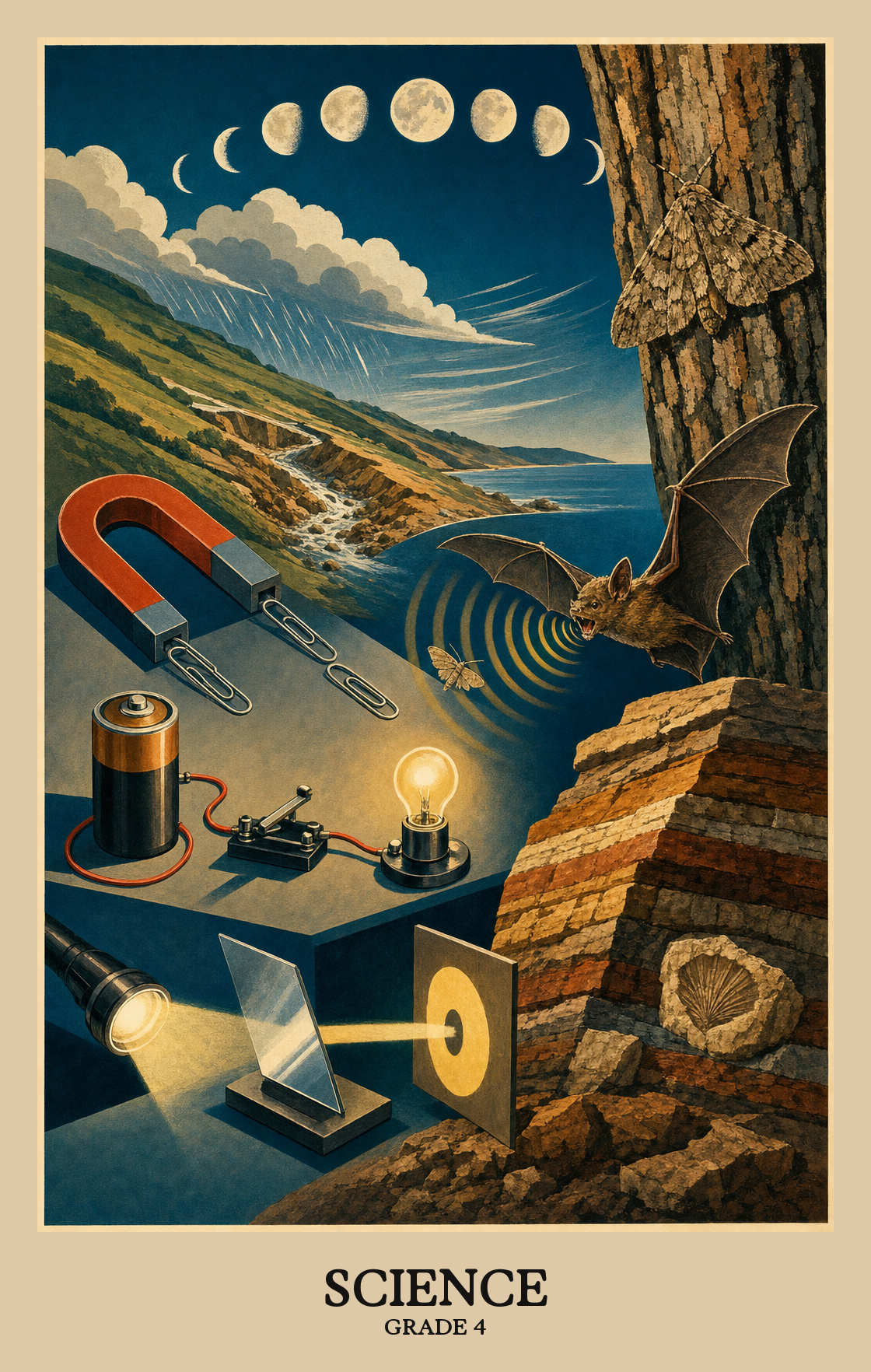
Students start the year exploring magnets and static electricity. They test how objects can push or pull each other without touching, and use what they notice to explain why things move.
Students look at how sound, heat, light, and electricity cause change. They build simple circuits, sort materials that let electricity through from ones that block it, and trace how light bounces off mirrors or bends through water.
Students study how plants and animals use their bodies and senses to stay alive. They look at why some animals in the same group survive better than others when their habitat changes.
Students compare fossils to animals and plants alive today. They use what fossils show to picture what an area looked like long ago and how it has changed.
Students model why we have day and night and why the moon looks different each week. They also sort minerals and rocks by their properties and look at how erosion, earthquakes, and volcanoes reshape the land.
Students wrap up the year by looking at how human choices help or hurt plants and animals. They compare solutions like recycling, rain gardens, and native plantings, and use evidence to back their thinking.
Forces like pushing, pulling, or gravity change how an object moves. Students learn to predict whether something will speed up, slow down, or change direction based on the forces acting on it.
Magnets push and pull other objects without touching them. Students ask questions and look for patterns in how two magnets attract or repel each other depending on how they are held.
Students test what happens when two electrically charged objects get close to each other, observing when they push apart or pull together and how that force moves objects.
| Standard | Definition | Code |
|---|---|---|
| Understand how various forces affect the motion of an object | Forces like pushing, pulling, or gravity change how an object moves. Students learn to predict whether something will speed up, slow down, or change direction based on the forces acting on it. | PS.4.1 |
| Ask questions to summarize the relationship of magnetic interactions between… | Magnets push and pull other objects without touching them. Students ask questions and look for patterns in how two magnets attract or repel each other depending on how they are held. | PS.4.1.1 |
| Carry out investigations to explain how electrically charged objects push… | Students test what happens when two electrically charged objects get close to each other, observing when they push apart or pull together and how that force moves objects. | PS.4.1.2 |
Sound, light, heat, and electricity can all move energy from one place to another. Students learn to recognize how each one carries energy and what changes when that energy arrives somewhere new.
Students learn that energy comes in forms like light, sound, heat, and electricity, and that each one can make things move or change. They practice asking questions about what kind of energy is at work in everyday situations.
Students draw or build a model of a simple circuit to show how a battery, wire, and bulb work together to move electricity and light the bulb.
Students test everyday materials like plastic, wood, metal, and rubber to find out which ones let electricity flow through (conductors) and which ones block it (insulators).
| Standard | Definition | Code |
|---|---|---|
| Understand that energy can be transferred from place to place by sound, light… | Sound, light, heat, and electricity can all move energy from one place to another. Students learn to recognize how each one carries energy and what changes when that energy arrives somewhere new. | PS.4.2 |
| Ask questions to identify basic forms of energy | Students learn that energy comes in forms like light, sound, heat, and electricity, and that each one can make things move or change. They practice asking questions about what kind of energy is at work in everyday situations. | PS.4.2.1 |
| Use models to explain a simple electrical circuit and the necessary components | Students draw or build a model of a simple circuit to show how a battery, wire, and bulb work together to move electricity and light the bulb. | PS.4.2.2 |
| Carry out investigations on common materials to classify them as insulators or… | Students test everyday materials like plastic, wood, metal, and rubber to find out which ones let electricity flow through (conductors) and which ones block it (insulators). | PS.4.2.3 |
Students learn what light is and how it behaves when it hits different objects, such as bouncing off a mirror, passing through glass, or being absorbed by a dark surface.
Students shine a light at a mirror and track where the beam goes. By changing the angle of the mirror, they figure out the rule for how light bounces.
Students investigate what happens when light passes through water or glass and bends, and why some objects feel warm after sitting in sunlight. Both effects come down to how materials interact with light.
| Standard | Definition | Code |
|---|---|---|
| Understand the nature of light and how light interacts with objects | Students learn what light is and how it behaves when it hits different objects, such as bouncing off a mirror, passing through glass, or being absorbed by a dark surface. | PS.4.3 |
| Carry out investigations to infer the path light travels from a light source to… | Students shine a light at a mirror and track where the beam goes. By changing the angle of the mirror, they figure out the rule for how light bounces. | PS.4.3.1 |
| Carry out investigations to explain how light is refracted and absorbed | Students investigate what happens when light passes through water or glass and bends, and why some objects feel warm after sitting in sunlight. Both effects come down to how materials interact with light. | PS.4.3.2 |
Students learn why some animals and plants survive when their habitat changes and others don't. They look at body features and behaviors, like a bear hibernating or a cactus storing water, that help living things adjust.
Plants and animals have outside body parts built for survival. Students use models to explain how a cactus spine, a bird's beak, or a bear's fur helps each creature stay alive in its habitat.
Animals take in information through their senses, process it in the brain, and react. Students use diagrams or models to show how an animal might hear a sound, decide what it means, and then respond.
Some animals in a group are born slightly different from others. Students look at evidence to explain why those differences can help certain animals survive and have offspring when their habitat changes.
Fossils are clues left behind by ancient plants and animals. Students learn what fossils tell us about creatures that lived long ago and how life on Earth has changed over time.
Students look at fossils and compare them to animals and plants alive today, using those similarities and differences as clues about what life looked like long ago.
Fossils are clues about what Earth looked like long ago. Students study fossil evidence to figure out what the climate, plants, and animals of a place might have been like before humans were around to record it.
| Standard | Definition | Code |
|---|---|---|
| Understand the effects of environmental changes, adaptations, and… | Students learn why some animals and plants survive when their habitat changes and others don't. They look at body features and behaviors, like a bear hibernating or a cactus storing water, that help living things adjust. | LS.4.1 |
| Use models to explain that plants and animals have external structures… | Plants and animals have outside body parts built for survival. Students use models to explain how a cactus spine, a bird's beak, or a bear's fur helps each creature stay alive in its habitat. | LS.4.1.1 |
| Use models to explain that animals receive different types of… | Animals take in information through their senses, process it in the brain, and react. Students use diagrams or models to show how an animal might hear a sound, decide what it means, and then respond. | LS.4.1.2 |
| Engage in argument from evidence to explain how differences among animals of… | Some animals in a group are born slightly different from others. Students look at evidence to explain why those differences can help certain animals survive and have offspring when their habitat changes. | LS.4.1.3 |
| Understand the use of fossils as evidence of the history of Earth and… | Fossils are clues left behind by ancient plants and animals. Students learn what fossils tell us about creatures that lived long ago and how life on Earth has changed over time. | LS.4.2 |
| Analyze and interpret data to compare fossils to one another and… | Students look at fossils and compare them to animals and plants alive today, using those similarities and differences as clues about what life looked like long ago. | LS.4.2.1 |
| Analyze and interpret data to explain how fossils suggest ideas about Earth's… | Fossils are clues about what Earth looked like long ago. Students study fossil evidence to figure out what the climate, plants, and animals of a place might have been like before humans were around to record it. | LS.4.2.2 |
Day and night happen because Earth spins, putting one side in sunlight and the other in shadow. Moon phases happen because we see different amounts of the sunlit side of the moon as it travels around Earth each month.
Students use a model, like a globe and a flashlight, to show why Earth's spin gives us day and night. The side facing the sun gets light; the side turned away goes dark.
Students learn why the moon looks different each night by using diagrams or models to trace its cycle from a thin crescent to a full circle and back. The pattern repeats every month.
| Standard | Definition | Code |
|---|---|---|
| Understand the causes of day and night and phases of the moon | Day and night happen because Earth spins, putting one side in sunlight and the other in shadow. Moon phases happen because we see different amounts of the sunlit side of the moon as it travels around Earth each month. | ESS.4.1 |
| Use models to explain the cause of day and night based on the rotation of the… | Students use a model, like a globe and a flashlight, to show why Earth's spin gives us day and night. The side facing the sun gets light; the side turned away goes dark. | ESS.4.1.1 |
| Use models to explain the repeating pattern of the phases of the moon | Students learn why the moon looks different each night by using diagrams or models to trace its cycle from a thin crescent to a full circle and back. The pattern repeats every month. | ESS.4.1.2 |
Students study how Earth's surface changes over time, from earthquakes and volcanoes reshaping land quickly to wind and water wearing it down slowly. They look for patterns in how and why those changes happen.
Students test real minerals by scratching, rubbing, and examining them to sort each one by how hard it is, what color it leaves on a surface, and how its surface reflects light.
Students sort rocks into three groups by studying what they are made of and how they formed. Heat and pressure make one kind, layered sediment makes another, and cooled magma makes the third.
Students use diagrams or physical models to show how Earth's surface changes, from slow shifts like wind and water wearing down rocks to sudden events like earthquakes or volcanic eruptions.
| Standard | Definition | Code |
|---|---|---|
| Understand patterns of change in the Earth's surface over time | Students study how Earth's surface changes over time, from earthquakes and volcanoes reshaping land quickly to wind and water wearing it down slowly. They look for patterns in how and why those changes happen. | ESS.4.2 |
| Carry out investigations to classify minerals using tests for the… | Students test real minerals by scratching, rubbing, and examining them to sort each one by how hard it is, what color it leaves on a surface, and how its surface reflects light. | ESS.4.2.1 |
| Carry out investigations to classify rocks as metamorphic, sedimentary | Students sort rocks into three groups by studying what they are made of and how they formed. Heat and pressure make one kind, layered sediment makes another, and cooled magma makes the third. | ESS.4.2.2 |
| Use models to explain changes in Earth's surface over time | Students use diagrams or physical models to show how Earth's surface changes, from slow shifts like wind and water wearing down rocks to sudden events like earthquakes or volcanic eruptions. | ESS.4.2.3 |
Students study how human actions, like building roads or cutting down forests, change the land, water, and air around them. They learn to recognize which changes cause problems for plants, animals, and people.
Students look at changes in a habitat, like a forest being cleared or a pond being cleaned up, and figure out whether those changes help or hurt the animals and plants living there.
Students look at real examples like rain gardens or recycling programs and use evidence to argue which human behaviors help people live safely in a changing environment.
Students look at real environmental problems affecting plants and animals, then compare different solutions to decide which ones actually help.
| Standard | Definition | Code |
|---|---|---|
| Understand changes caused by human impact on the environment | Students study how human actions, like building roads or cutting down forests, change the land, water, and air around them. They learn to recognize which changes cause problems for plants, animals, and people. | ESS.4.3 |
| Ask questions to infer whether changes in an organism's environment… | Students look at changes in a habitat, like a forest being cleared or a pond being cleaned up, and figure out whether those changes help or hurt the animals and plants living there. | ESS.4.3.1 |
| Engage in argument from evidence to explain how humans can adapt their behavior… | Students look at real examples like rain gardens or recycling programs and use evidence to argue which human behaviors help people live safely in a changing environment. | ESS.4.3.2 |
| Obtain, evaluate and communicate information to compare solutions… | Students look at real environmental problems affecting plants and animals, then compare different solutions to decide which ones actually help. | ESS.4.3.3 |
Alternate assessment for eligible students with significant cognitive disabilities, covering state-tested grades and subjects.
Federally administered sample-based assessment in reading, mathematics, science, writing, and other subjects. NAEP results inform state-by-state comparisons rather than individual student or school accountability.
Students study forces like magnets and static electricity, basic circuits, light and mirrors, animal and plant survival, fossils, the moon and Earth's rotation, rocks and minerals, and how people affect the environment. Most of it happens through hands-on investigations and building simple models.
Try short, real experiments. Rub a balloon on hair to see static pull, shine a flashlight at a mirror to see how light bounces, or check the moon each night for a week and sketch its shape. Ask what students noticed and what surprised them.
Some words matter, like conductor, insulator, reflect, refract, igneous, sedimentary, and metamorphic. But knowing what the words mean in a real example matters more than reciting definitions. Ask students to point to a conductor in the kitchen or name a rock outside.
A common path is forces and energy in the fall, light and circuits in the winter, then life science and fossils, with Earth systems and human impact in the spring. Save moon phases for a stretch when families can observe at home over several weeks.
Moon phases, the difference between reflection and refraction, and classifying rocks tend to stick less than expected. Plan to revisit these with models and repeated investigations rather than a single lesson. Fossils as evidence of past environments also needs more than one pass.
Students should ask a question, try something, record what happened, and explain the result with evidence. Keep materials simple: magnets, batteries and bulbs, flashlights, mirrors, rock samples, and water. The thinking matters more than fancy equipment.
Tie it to something they can touch. Take apart an old flashlight, hunt for rocks on a walk, or watch ants and talk about how their bodies help them survive. Science feels different when it leaves the worksheet.
By spring, students should explain a simple circuit, predict how light behaves with a mirror, sort rocks and minerals by physical properties, describe why we have day and night, and use evidence to argue about survival or human impact. Look for explanations, not just labels.
Focus on what people can do, not just what is going wrong. Students compare solutions like recycling, rain gardens, and planting native species, then argue which fits a local problem. The unit lands better when it ends with action students can picture.