Big numbers and place value
Students read, write, and compare numbers up to 100,000. They learn that the same digit means ten times more when it shifts one spot to the left, which sets up the bigger math that follows.
This is the year math stretches into bigger numbers and into fractions that students can actually compare. Students work with numbers up to 100,000, multiply two-digit numbers, and divide with remainders. Fractions become real quantities students add, subtract, and line up against each other, and decimals like 0.7 start showing up too. By spring, students can add and subtract fractions with the same bottom number and measure an angle with a protractor.
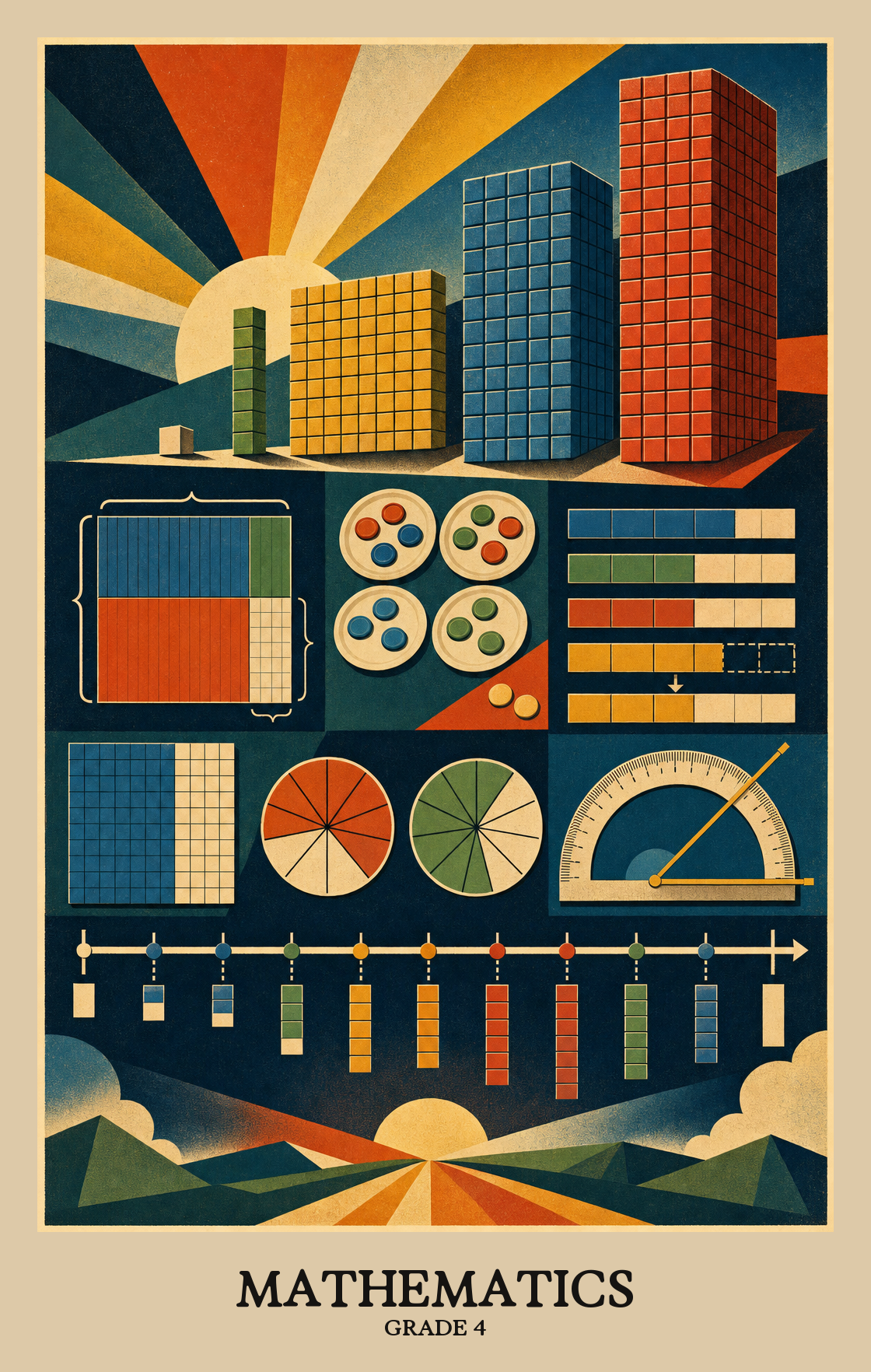
Students read, write, and compare numbers up to 100,000. They learn that the same digit means ten times more when it shifts one spot to the left, which sets up the bigger math that follows.
Students multiply larger numbers and divide with remainders. They use drawings, area models, and the standard method, and they tackle two-step word problems where they have to decide what the leftover amount means.
Students find the factor pairs of numbers up to 50 and decide whether a number is prime or composite. They also build and extend number and shape patterns that follow a rule.
Students compare fractions with different denominators, add and subtract fractions with the same bottom number, and multiply a fraction by a whole number. They also start writing tenths and hundredths as decimals.
Students work with metric units like centimeters, grams, and liters, and convert from larger units to smaller ones. They solve area and perimeter problems for rectangles and add and subtract time across the hour.
Students sort triangles and four-sided shapes by their sides and angles, measure angles with a protractor, and find lines of symmetry. They also collect data and show it in bar graphs and line plots.
Students read a two-step word problem, choose which operations to use, and solve it. They check whether the answer makes sense, handle leftovers when dividing, and use a letter like n to stand for the missing number.
Students find every pair of whole numbers that multiply to make a given number, up to 50. They also decide whether a number can only be divided evenly by 1 and itself, or whether it has other divisors.
Students follow a rule (like "add 3" or "double it") to build a number sequence or shape pattern, then describe what they notice. The focus is on spotting what stays the same and predicting what comes next.
| Standard | Definition | Code |
|---|---|---|
| Solve two-step word problems involving the four operations with whole… | Students read a two-step word problem, choose which operations to use, and solve it. They check whether the answer makes sense, handle leftovers when dividing, and use a letter like n to stand for the missing number. | NC.4.OA.3 |
| Find all factor pairs for whole numbers up to and including 50… | Students find every pair of whole numbers that multiply to make a given number, up to 50. They also decide whether a number can only be divided evenly by 1 and itself, or whether it has other divisors. | NC.4.OA.4 |
| Generate and analyze a number or shape pattern that follows a given rule | Students follow a rule (like "add 3" or "double it") to build a number sequence or shape pattern, then describe what they notice. The focus is on spotting what stays the same and predicting what comes next. | NC.4.OA.5 |
Each place in a number is worth 10 times the place to its right. So the 3 in 3,000 is worth 10 times more than the 3 in 300.
Students read and write numbers up to 100,000 three ways: as digits (34,506), as words ("thirty-four thousand, five hundred six"), and broken apart by place value (30,000 + 4,000 + 500 + 6).
Students look at two numbers up to 100,000 and decide which is larger, smaller, or equal, then write that comparison using the symbols >, <, or =.
Students add and subtract whole numbers up to 100,000 using the standard written method, lining up digits by place value to work column by column.
Students multiply numbers like 24 x 36 or 312 x 7 by breaking them into parts based on place value. They use area models and partial products to see why the steps work before moving to the standard algorithm.
Students learn to divide numbers up to 999 by a single-digit number and find what's left over. They use drawings, arrays, and partial steps to see why division works, not just how to do it.
| Standard | Definition | Code |
|---|---|---|
| Explain that in a multi-digit whole number, a digit in one place represents 10… | Each place in a number is worth 10 times the place to its right. So the 3 in 3,000 is worth 10 times more than the 3 in 300. | NC.4.NBT.1 |
| Read and write multi-digit whole numbers up to and including 100,000 using… | Students read and write numbers up to 100,000 three ways: as digits (34,506), as words ("thirty-four thousand, five hundred six"), and broken apart by place value (30,000 + 4,000 + 500 + 6). | NC.4.NBT.2 |
| Compare two multi-digit numbers up to and including 100,000 based on the values… | Students look at two numbers up to 100,000 and decide which is larger, smaller, or equal, then write that comparison using the symbols >, <, or =. | NC.4.NBT.7 |
| Add and subtract multi-digit whole numbers up to and including 100,000 using… | Students add and subtract whole numbers up to 100,000 using the standard written method, lining up digits by place value to work column by column. | NC.4.NBT.4 |
| Multiply a whole number of up to three digits by a one-digit whole number | Students multiply numbers like 24 x 36 or 312 x 7 by breaking them into parts based on place value. They use area models and partial products to see why the steps work before moving to the standard algorithm. | NC.4.NBT.5 |
| Find whole-number quotients and remainders with up to three-digit dividends and… | Students learn to divide numbers up to 999 by a single-digit number and find what's left over. They use drawings, arrays, and partial steps to see why division works, not just how to do it. | NC.4.NBT.6 |
Students gather numerical data by asking a question, then display and read the results in a bar graph, frequency table, or line plot. They also decide whether a survey question will produce numbers or categories as answers.
Students measure length, mass, and liquid volume using metric units like centimeters, meters, grams, and liters. Then they add, subtract, multiply, or divide those measurements to solve word problems.
Students convert metric measurements like kilometers to meters or meters to centimeters by multiplying. They use place value patterns and simple tables to organize the work.
Students figure out how much time passes when an activity starts before the hour and ends after it, like a movie that begins at 2:45 and ends at 3:20. They add and subtract to find the answer.
Students find the area and perimeter of rectangles and irregular shapes made of right angles, then solve problems where one measurement stays fixed while the other changes, using real-world situations like rooms, fences, or garden beds.
Students learn what an angle is, measure angles in degrees using a protractor, and figure out missing angles by adding or subtracting the ones they already know.
| Standard | Definition | Code |
|---|---|---|
| Represent and interpret data using whole numbers.<ul><li>Collect data by asking… | Students gather numerical data by asking a question, then display and read the results in a bar graph, frequency table, or line plot. They also decide whether a survey question will produce numbers or categories as answers. | NC.4.MD.4 |
| Know relative sizes of measurement units | Students measure length, mass, and liquid volume using metric units like centimeters, meters, grams, and liters. Then they add, subtract, multiply, or divide those measurements to solve word problems. | NC.4.MD.1 |
| Use multiplicative reasoning to convert metric measurements from a larger unit… | Students convert metric measurements like kilometers to meters or meters to centimeters by multiplying. They use place value patterns and simple tables to organize the work. | NC.4.MD.2 |
| Solve word problems involving addition and subtraction of time intervals that… | Students figure out how much time passes when an activity starts before the hour and ends after it, like a movie that begins at 2:45 and ends at 3:20. They add and subtract to find the answer. | NC.4.MD.8 |
| Solve problems with area and perimeter.<ul><li>Find areas of rectilinear… | Students find the area and perimeter of rectangles and irregular shapes made of right angles, then solve problems where one measurement stays fixed while the other changes, using real-world situations like rooms, fences, or garden beds. | NC.4.MD.3 |
| Develop an understanding of angles and angle measurement.<ul><li>Understand… | Students learn what an angle is, measure angles in degrees using a protractor, and figure out missing angles by adding or subtracting the ones they already know. | NC.4.MD.6 |
Students learn the building blocks of geometry: the difference between a line that goes on forever, a segment with two endpoints, a ray with one, and angles where two rays meet. They also spot parallel lines that never cross and perpendicular lines that form a square corner.
Students sort quadrilaterals and triangles by their angles, side lengths, and whether their sides run parallel or meet at right angles. A square, a rectangle, and a rhombus each have different rules that put them in their own group.
Students learn to spot when a shape can be folded exactly in half so both sides match, then draw the fold line. A heart has one line of symmetry; a square has four.
| Standard | Definition | Code |
|---|---|---|
| Draw and identify points, lines, line segments, rays, angles | Students learn the building blocks of geometry: the difference between a line that goes on forever, a segment with two endpoints, a ray with one, and angles where two rays meet. They also spot parallel lines that never cross and perpendicular lines that form a square corner. | NC.4.G.1 |
| Classify quadrilaterals and triangles based on angle measure, side lengths | Students sort quadrilaterals and triangles by their angles, side lengths, and whether their sides run parallel or meet at right angles. A square, a rectangle, and a rhombus each have different rules that put them in their own group. | NC.4.G.2 |
| Recognize symmetry in a two-dimensional figure | Students learn to spot when a shape can be folded exactly in half so both sides match, then draw the fold line. A heart has one line of symmetry; a square has four. | NC.4.G.3 |
Students use drawings of shapes or number lines to show why two fractions that look different are actually the same size. They explain how cutting something into more pieces changes the piece size but not the total amount.
Students compare two fractions with different top and bottom numbers, deciding which is larger, smaller, or equal. They explain their reasoning using fraction strips or area models, and record the answer with >, =, or <.
Students break fractions into smaller pieces and put them back together. They add and subtract fractions with the same bottom number, including mixed numbers like 1 3/4, and solve word problems using drawings and equations.
Students learn that multiplying a whole number by a fraction is the same as taking a piece of that whole number. They practice this with word problems, like finding two-thirds of 12 apples or three-fourths of an hour.
Students connect fractions like 3/10 or 25/100 to decimal numbers like 0.3 and 0.25. They use grids and number lines to show why those two forms mean the same amount, then add fractions that share a base of 10 or 100.
Students compare two decimal numbers, like 0.4 and 0.35, by drawing grids or number lines to see which is larger. They record the result using >, =, or < and learn that the comparison only works when both numbers refer to the same whole.
| Standard | Definition | Code |
|---|---|---|
| Explain why a fraction is equivalent to another fraction by using area and… | Students use drawings of shapes or number lines to show why two fractions that look different are actually the same size. They explain how cutting something into more pieces changes the piece size but not the total amount. | NC.4.NF.1 |
| Compare two fractions with different numerators and different denominators… | Students compare two fractions with different top and bottom numbers, deciding which is larger, smaller, or equal. They explain their reasoning using fraction strips or area models, and record the answer with >, =, or <. | NC.4.NF.2 |
| Understand and justify decompositions of fractions with denominators of 2, 3… | Students break fractions into smaller pieces and put them back together. They add and subtract fractions with the same bottom number, including mixed numbers like 1 3/4, and solve word problems using drawings and equations. | NC.4.NF.3 |
| Apply and extend previous understandings of multiplication to:<ul><li>Model and… | Students learn that multiplying a whole number by a fraction is the same as taking a piece of that whole number. They practice this with word problems, like finding two-thirds of 12 apples or three-fourths of an hour. | NC.4.NF.4 |
| Use decimal notation to represent fractions.<ul><li>Express, model and explain… | Students connect fractions like 3/10 or 25/100 to decimal numbers like 0.3 and 0.25. They use grids and number lines to show why those two forms mean the same amount, then add fractions that share a base of 10 or 100. | NC.4.NF.6 |
| Compare two decimals to hundredths by reasoning about their size using area and… | Students compare two decimal numbers, like 0.4 and 0.35, by drawing grids or number lines to see which is larger. They record the result using >, =, or < and learn that the comparison only works when both numbers refer to the same whole. | NC.4.NF.7 |
End-of-grade mathematics assessment for grades 3 through 8, aligned to the North Carolina Standard Course of Study.
Alternate assessment for eligible students with significant cognitive disabilities, covering state-tested grades and subjects.
Federally administered sample-based assessment in reading, mathematics, science, writing, and other subjects. NAEP results inform state-by-state comparisons rather than individual student or school accountability.
Students work with larger numbers up to one hundred thousand, multiply and divide bigger problems, and start adding and subtracting fractions. They also measure angles, find area and perimeter, and begin connecting fractions to decimals like 0.25 and 0.7.
Practice multiplication facts in short bursts, about five minutes a day, until they feel automatic. Then move to problems like 23 times 4 or 84 divided by 3. Ask students to explain their thinking out loud so they catch their own mistakes.
Fractions are the bridge to decimals, percentages, and most of the math that comes later. Students learn to compare fractions like 3/4 and 2/3, add fractions with the same bottom number, and see that 1/2 of a pizza is the same as 2/4. Cooking and cutting food are easy ways to practice.
A common path is place value first, then multi-digit multiplication and division, then fractions in the middle of the year, then decimals as an extension of fractions. Geometry, angles, and measurement work well in shorter units between the bigger blocks.
Long division with remainders, comparing fractions with different bottom numbers, and converting between metric units tend to take the longest. Plan extra practice time for these, and expect to revisit them after the first unit ends.
By spring, students should solve two-step word problems, multiply a three-digit number by a one-digit number, add and subtract fractions with the same bottom number, and measure angles with a protractor. They should also read and write numbers up to one hundred thousand.
Use real situations: a grocery total split between two people, the time left until a show ends, or the area of a bedroom rug. Ask students to write the equation first and check whether the answer makes sense before moving on.
Students are ready when they can multiply two-digit by two-digit numbers, divide three-digit numbers by one-digit numbers with remainders, compare fractions and decimals, and solve multi-step problems without needing the steps spelled out. Fluency with multiplication facts is the strongest predictor.